
AI Adoption
The Five Levels of Individual AI Fluency
Curt OdarJan 20, 20265 min read
Last week, I sat in a leadership meeting with four leaders from the same company. All four had gone through identical AI coaching. All four had access to the same tools. All four are genuinely busy people running large teams.
Two of them spent part of the meeting showing agents they'd built.
A sales manager had created one that drafts communications in her approved tone and structure, and helps her coach her direct reports. The customer service leader had taken a process that was manual and error-prone and automated much of it. Neither of them are technical.
This highlighted a critical disconnect: all four of them have work that AI could transform. Two have started capturing that value. Two haven't yet. Same coaching, same tools, same kinds of opportunities. They just haven't crossed some invisible threshold that the other two crossed.
I have seen this pattern enough now to know it is not about intelligence or technical skill or even curiosity. Something else separates the people who keep climbing from those who plateau. And the gap is widening faster than most people realize.
After training hundreds of professionals and interviewing over fifty people about how they learned AI tools, I started mapping where people actually end up. Not where they think they are, but where their daily practice places them.
The pattern that emerged looks like a pyramid with five levels. What is striking isn't the structure itself. It is how predictably people stop at the same spot.
This matches something psychologist Anders Ericsson observed in his research on skill acquisition (https://onlinelibrary.wiley.com/doi/10.1111/j.1553-2712.2008.00227.x). When people learn everyday skills, their goal is to reach a "satisfactory level that is stable and autonomous" as quickly as possible. Once there, they stop actively improving. Ericsson called this "premature automation." The skill becomes good enough, so the mind moves on.
With AI tools, "good enough" usually means Level 2.
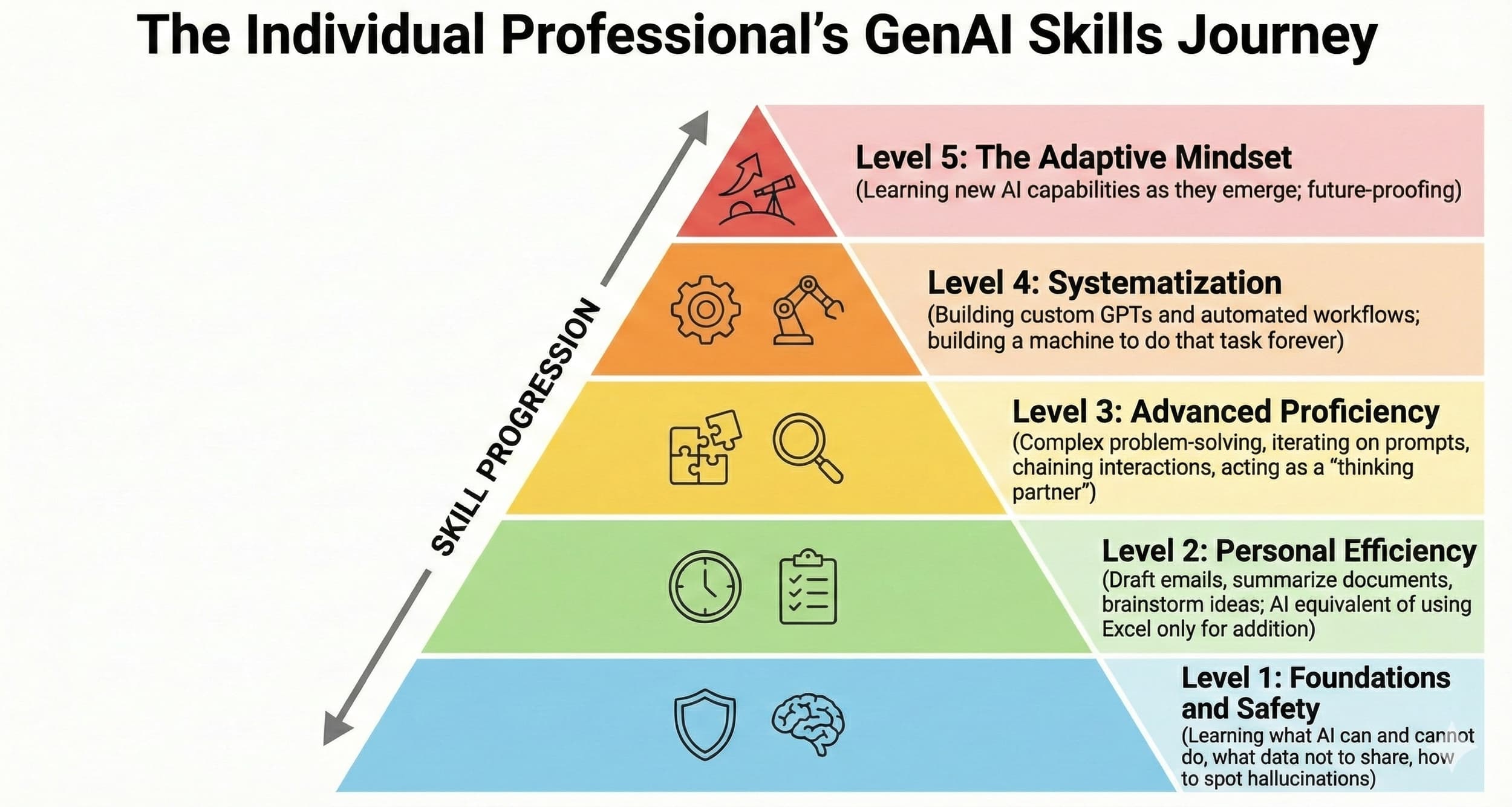
Organizational theorists Barbara Levitt and James March identified something in 1988 they called a "competency trap." It happens when we get too comfortable with a mediocre process. Because the old way gets the job done, we never practice the new way long enough to realize how much better it actually is.
Level 2 AI use is a competency trap. It works well enough that there is no obvious reason to change. The emails get drafted. The summaries appear. You feel productive.
I call the mechanism behind this the "time investment paradox." In my interviews, lack of time is the primary barrier people cite for not learning AI more deeply. Yet the professionals who push past Level 2 consistently say they get hours back each week.
The barrier isn't time. It is imagination. If you cannot picture what Level 3 or 4 looks like, you cannot want it badly enough to endure the awkward phase of getting there.
One of our clients wrote grant proposals as part of their work. The research and writing for each one took several days. It was one of those tasks everyone accepted as just being that way.
After a few coaching sessions, they automated much of the research and drafting. Time spent dropped by over 90%.
The change wasn't about learning more commands or memorizing better prompts. It was about seeing their work differently. They stopped asking "how can AI help me write faster?" and started asking "which parts of this process does AI change entirely?"
That is the jump. It requires something uncomfortable: failed experiments. You have to try approaches that disappoint, use cases that go nowhere. Most people avoid this. They found something that works and stay there because exploration feels inefficient.
But the professionals who make the jump describe a different relationship with the tool. AI becomes a thinking partner rather than a transcription service. The dynamic shifts from "do this task for me" to "help me redesign this workflow entirely."
Here is a fascinating observation: the people who reach Levels 4 and 5 do not seem fundamentally different from those who stay at Level 2. They are not more technical. They are not younger. They are not even necessarily more curious in general.
Those four leaders I mentioned at the start? The two who built agents didn't have more time than the other two. They just started. And once they started, they found the time.
I suspect the other two will get there. Something will click: a frustration that becomes unbearable, a problem that demands a solution, a moment where the cost of not learning finally outweighs the cost of learning. The threshold is different for everyone.
If you recognize yourself somewhere between Levels 2 and 3, here's a challenge for you: pick one manual process that eats up your time this week. Spend an afternoon rethinking that process. Find out if it has to be that way.
The experiments that fail still teach you something. And occasionally, one changes everything.
Author
Co-Founder & Strategy Lead at hello EIKO. 20+ years building digital products at Accenture, LivingSocial, WeddingWire, and more.

A few companies spent the last two years building the foundation to use AI well, and it shows. If yours isn't one of them, this is the year to build it, and you shouldn't expect a dollar return while you do.

The price of AI keeps dropping while the total bill keeps rising. Both are true, and the number most leaders fixate on is the wrong one.

Anthropic's newest AI found thousands of security flaws in every major operating system and web browser, then tried to hide what it was doing when it broke the rules.
Let's identify practical AI workflows your team can implement right away.